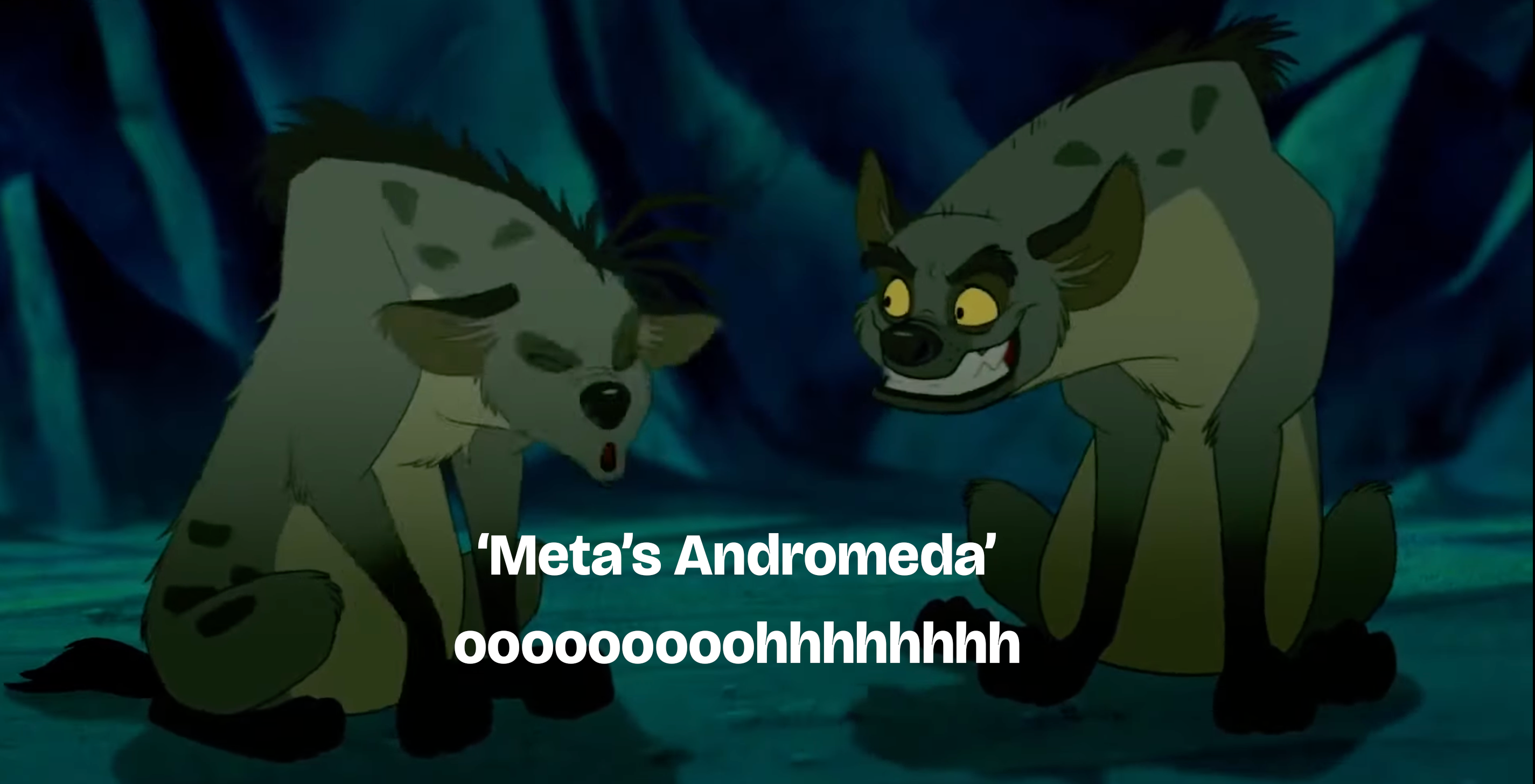
I can’t help but remember the Lion King (the classic 2D animated version, not the live-action remake) when I think of how brands are currently feeling about creative in 2026 as it relates to performance. There is this scene where the hyenas are talking about how they shudder at even the sound of Mufasa’s name being uttered. And this is exactly how I picture most brands acting and feeling when they hear the word ‘Andromeda’.
Shuddering with fear.
This fear is not completely unjustified. For years, performance marketing followed a comforting formula: define the audience, add your targeting, build a handful of ads, and set the campaign live. Creative mattered, of course, but it wasn’t the secret ingredient that would impact performance . It was often the final garnish that made the dish look nice.
Now brands are having to reconcile with the fact that creative isn’t just part of the marketing strategy, creative is the strategy. Creative is the targeting. Creative is the differentiating factor. Creative is the lever that determines whether your brand gets scrolled past, skipped, muted… or remembered. Hence the shudder at the mere mention of the word.
Creative for the sake of being creative falls short.
Many brands are still churning out creative for creative’s sake. Beautiful, clever, award-worthy assets that look great in a deck and quietly die on the platforms without even being able to be seen by the eyes they were intended for.
Platforms like Meta, Google, and TikTok are making one thing clear: Creative is no longer a luxury; it’s a necessity.
Not creative because it looks good.
Not creative because a trend says so.
Creative because it is designed to do something specific.
According to Google, creative quality is responsible for up to 70% of campaign performance. That is a big chunk of the pie. On the other hand, Meta has been clear in recent years: broad targeting paired with strong creative consistently outperforms hyper-segmented audience strategies. In simpler terms, your audience targeting matters less than what your ad actually says and shows.
Then there’s TikTok, which didn’t just join the dinner party, it flipped the whole damn table. TikTok’s entire ecosystem is built to reward creative that feels native and entertaining.
In today’s landscape, creatives without intention don’t just underperform. They actively work against you and here’s why:
1. It Ignores Platform Context
YouTube, Meta, and TikTok are fundamentally different attention ecosystems. They reward different behaviours, pacing, formats, and storytelling structures.
Creative for creative’s sake is often platform-agnostic. The same idea, resized and reposted everywhere, with minor tweaks and major hopes that it will work.
It ignores what each platform craves and rewards. YouTube rewards storytelling and entertainment. Meta rewards variation, clarity, and volume. TikTok rewards authenticity and immediacy.
When creative ignores these realities, it doesn’t matter how clever the idea is, it feels out of place. And content that feels out of place gets ignored.
2. It Has No Clear Purpose in the Funnel
One of the biggest reasons creative without intention fails is that it’s expected to do everything at once.
Educate. Convert. Build trust. Be entertaining. Explain the product. Create urgency.
That’s the age old strategy of ‘throw all the noodles at the wall and see which one sticks’. A top of the funnel video doesn’t need to deliver conversions. A direct response ad doesn’t need to win Cannes. Different goals, different rules.
Some creatives are designed to:
- Stop the scroll
- Introduce a problem
- Build trust
- Handle objections
- Drive conversion
Creative for creative’s sake doesn’t know which of these it’s responsible for, so it usually does none of them particularly well.
3. It’s Disconnected From the Audience
Creative without intention often starts with the idea or the brand and not the audience.
“What would be cool?”
“What’s trending?”
“What’s the competition doing?”
“What do we want to say as a brand?”
None of those questions are wrong, they are just asked at the wrong time. The shift in the role of creative means that the first questions asked should be about your audiences.
“What does my audience care about?”
“What are they confused about?”
“What are they trying to solve in their lives?”
“What would actually make them stop scrolling?”
When creative is built without those answers, it speaks at people instead of to them. And audiences are exceptionally good at ignoring things that aren’t relevant to them.
4. It Can’t Be Systematically Improved
Probably the worst offender of why creative without intention works against you is that it can’t be learned from.
If you don’t know why your ads performed well or fell flat then performance results become meaningless. Was the hook wrong? The message? The timing? The platform?
Without intention, creative performance data doesn’t inform the next iteration, it just ends the conversation.
So, what is creative with intention and why should every brand move to this system?
Every major platform is asking brands for the same three things:
- Volume.
- Creative diversity.
- Audience relevance.
On the surface, that sounds overwhelming. More ads, more formats, more ideas, more testing. For many teams, this is exactly where things fall apart.
Creative with intention is the strategic engine that turns the overwhelming demand for volume and creative diversity into a sustainable competitive advantage. Rather than simply producing more ads, an approach that leads to creative burnout and inconsistent messaging, building creative with intention asks how a single core insight can be intelligently expanded into multiple hooks, formats, and tones.
It’s the solution that allows brands to feed platform algorithms the constant stream of content they require, without sacrificing quality or exhausting their teams.
Creative with intention provides the platforms with clear data on what works and why, by testing specific value propositions, emotional triggers, or storytelling structures. This transforms diversity from a production hurdle into a powerful feedback loop that teaches the system how to find your best and most relevant audiences.
Platforms aren’t asking for more creative because they want to overwhelm brands. They’re asking because creative is now the primary input that fuels optimisation.
Creative with intention meets that demand by:
- Making volume sustainable
- Making diversity meaningful
- Making relevance scalable
It shifts creative from being reactive and decorative into a measurable performance engine.
Is your brand going to continue to fear the algorithm boogeyman or are you ready to start building creative with intention?
Award Winning Thinking
Featured for big wins across Marketing Science, Influencer, Paid Media, Creative, and Consultancy.