
Christmas is expensive. Everyone knows it, everyone can predict it, yet surprisingly few people do anything about it.
Whether you are at the petrol station on Christmas Eve desperately buying last minute flowers, or ramping up media budgets on 12th December, the last minute Christmas rush is expensive, stressful and often unsuccessful.
December arrives, every retailer in the category needs the same eyeballs in the same six weeks, and the cost of reaching them goes up. And usually goes up a lot. Most brands build this cost into their forecasts, expect to pay more, grit their teeth and pay it anyway.
But there is another way.
A way to beat the Christmas rush.
Slowly buying your christmas presents across a few months rather than rush buying them all on Christmas Eve.
The channels that build demand don’t pay off the week you spend on them, they pay off weeks later. Often that lag time is seen as a negative, “I have to wait 4 weeks for CTV to show value, while search campaigns will generate revenue this week.”
But it is also a crucial lever to avoid these spikes in inventory costs.
If you invest early, while inventory is still cheaper, you can buy the impact in October and harvest it right through December, while your competitors are fighting for the last minute inventory at inflated prices.
1. The cost of a last minute shopper
The impact of increased spend in Christmas peak is well known and measurable. Media cost increases.
The effect is not evenly spread across platforms, though.
Customer demand goes up at Christmas, it is why marketing spend increases in the first place. And as that demand goes up, retail focused searches also increase. This helps to hold some of the increase in Google prices, while demand is increasing, supply increases to match. So total spend increases but price inflation is held to a lower level.
Social platforms show a different effect. Supply is relatively flat (people don’t suddenly spend significantly more time on platform because it is christmas) so the increase in demand causes a significant increase in auction prices. Above 20% on TikTok and Meta.
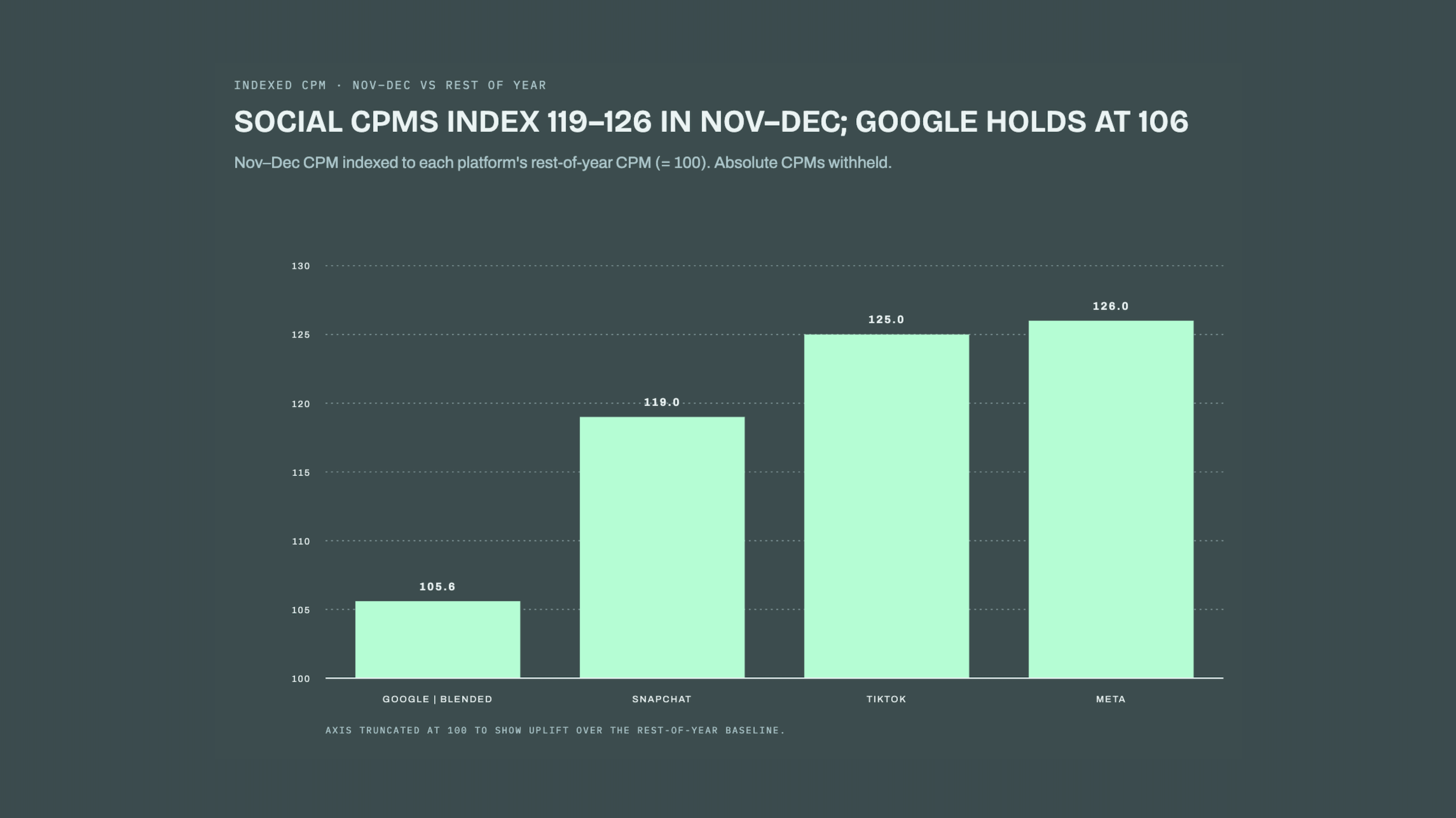
Meta CPM ran 26% higher in Nov-Dec versus the rest of the year, 90% of accounts see an increase, the 10% that don’t are primarily due to other changes affecting the campaigns.
TikTok and Snapchat showed a real but smaller premium, +25% and +19% respectively.
Google cost increased but to a smaller extent as supply flexes at the same time as demand.
Industry benchmark data tells the same story, only sharper at the extremes: Meta CPMs typically run 20 to 50% higher through Q4, with the single most expensive days, Black Friday, Cyber Monday and the fortnight before Christmas, spiking 50 to 100%+ above the annual baseline.
2. Buying presents all quarter
You don’t pay these price premiums for demand you have already built.
The channels that create awareness and consideration do not stop working the day you stop spending on them, they carry forward. COmpass, our marketing-mix model, quantifies exactly how long that carry lasts, channel by channel.
Across our modelling, lower-funnel activity such as search, retargeting and shopping lands more quickly in revenue, while upper- and mid-funnel activity such as social prospecting, video and demand gen can continue contributing for several weeks after the spend lands.
On one of our retail client’s COmpass model, paid social was still delivering a meaningful share of its revenue three to six weeks after the spend landed, well after the campaign had moved on to the next thing.
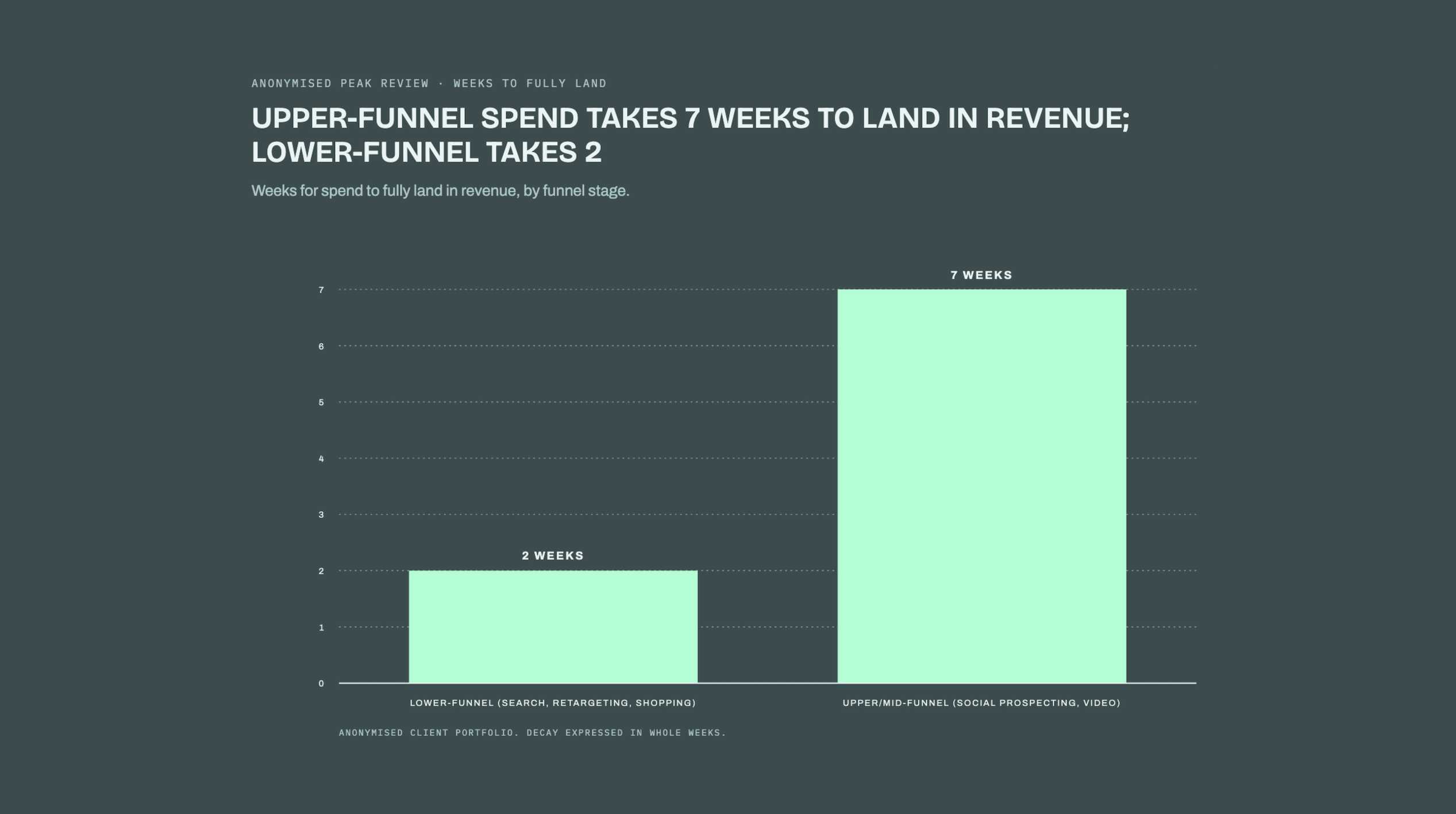
Lower funnel lands in about two weeks, upper and mid funnel closer to seven.
Work back seven weeks from the December revenue peak and you land in the last week of October. That is when the savvy shopper buys their Christmas marketing presents
3. The savvy shopper
This is the positive tradeoff. The savvy shopper dividend.
Buy reach and consideration in October and early November, when CPMs are still at baseline, and let the lag deliver the payoff exactly when demand, and everyone else’s cost, peaks through December.
Spreading your present buying across Q4, so you get some cheaper gifts in October to allow you to focus on the last minute opportunities in December
Four things make this work in practice, drawn from real peak planning with our clients:
-
- Scale in gradually, not in huge jumps. Large week-on-week budget jumps can be difficult for channels to absorb efficiently, so upper- and mid-funnel activity should already be ramping several weeks before peak rather than switching on at full force.
- Launch gifting activity ahead of the demand, not alongside it. In our peak planning, gifting campaigns introduced early and scaled gradually delivered stronger, more sustained returns than activity launched only once demand had already arrived. Christmas shoppers are not buying for themselves, so the consideration window is longer and it opens earlier than most plans assume.
- Treat the pre-peak weeks as a media buy, not a warm-up. The cheapest CPMs sit in September and October. That is precisely when the longest-lag channels need to be live.
- Measure Forward Indicators of Demand, not ROAS. ROAS will appear worse. That is the plan, you are investing in future performance not buying performance today. That doesn’t mean you can’t measure anything. Find your statistical Forward Indicators of Demand, measure them and optimise towards them so that your campaigns are efficient at driving future performance.
4. Put the daily advent calendar next to the yearly planner
The forward plan should set a direction, but you shouldn’t follow it blindly. Adjust to the day by day performance, but on forward indicators not daily ROAS.
Daily budget pacing will not spend a set amount on a set day, it will blend over a rolling week, so a budget change made in reaction to Wednesday’s numbers does not show up cleanly until the weekend. Search campaigns that tighten bids to protect against overspend can also take time to ramp back up once given the green light.
A model built in September tells you where to place your bets. It cannot tell you, in real time, that a campaign is under or over performing in the last week.
You need both the yearly planner, and the daily performance view. Both are valuable and should work together.
We do this through strategic long term models, and daily performance models:
- COmpass, for the medium-term calls. Where to shift budget between channels months out, how much lag to plan for, what the scenario planner says a given shift in October spend does to December revenue. This is the layer that answers whether to move budget upper-funnel six weeks before peak, before the quarter starts.
- Signal, for the short-term read. Week-to-week and day-to-day: is spend actually landing where the plan said it would, has a channel’s efficiency moved enough to act on now, is one pacing rule fighting another. This is the layer that catches activity that is performing above or below expectations.
Run only the first and you have a smart plan that goes stale the moment Christmas trading gets messy. Run only the second and you are permanently reacting, buying inventory at whatever price the auction sets that hour.
Together, they are what let a plan set in September survive contact with Christmas decorations.
The final gift
The cost of media inventory in November and December is not a tax you have to accept.
It is the price of only focusing on last minute shopping. The petrol station flowers tax. It doesn’t have to be that way.
The savvy shopper understands the lag between spend and revenue by channel, and knows how to use it to create an edge vs competitors who do not have.
Use that knowledge and adapt it to the daily trading performance, and October becomes the cheapest, highest-leverage month in the Christmas plan, not the quiet one before it.