Reach has become one of the most talked about metrics in modern advertising. Platforms encourage advertisers to maximise it, planners optimise towards it and media plans are often judged by how many people they can expose to a message.
Reach is only one part of the equation. Advertising only works when people remember it. Building those memory structures requires repeated exposure over time, and the number of exposures needed depends entirely on the environment you’re advertising in.
Take a TV ad, viewed on a large screen with sound on and limited distractions, naturally commands more attention than a display banner appearing halfway down a webpage. Those two impressions aren’t equal, so they shouldn’t be measured as though they are. Higher-attention channels tend to require fewer exposures to build memory, while lower-attention environments often need greater frequency before people begin to recognise, recall and respond to a brand.
Frequency creates familiarity
Meta recently shared research exploring how aggregate attention can deliver a +32% sales impact than continuous attention. Rather than relying on one memorable exposure, the evidence points towards the value of continuous, repeated exposure over time. Individual impressions don’t always need to be long or highly engaging. What matters is maintaining a consistent presence so that brands remain mentally available when purchasing decisions are made.
It’s entirely possible to build a campaign that reaches millions of people while generating an average frequency of two impressions per month. On paper, that can look incredibly efficient. In reality, it’s unlikely to generate enough repeated exposure to strengthen brand memory or create a measurable shift in consideration and demand.
Finding the right balance
There’s no universal frequency target. It depends on the channel, the creative, the buying cycle and the category.
It’s important to understand the trade-off when making these decisions. Expanding audiences indefinitely often improves reach but dilutes frequency. Narrowing audiences increases the likelihood that people see the advertising often enough to remember it, but can reduce overall penetration if budgets don’t support the required scale.
We recently tested this with a client by deliberately reducing audience size. The campaign moved from an average frequency of just over one impression per week to more than two. The result was a positive shift in brand search alongside improvements in wider business outcomes. The improvement came from increasing the likelihood that people encountered the brand often enough for those exposures to accumulate.
Investment matters
Maintaining meaningful frequency requires sufficient investment to continue reaching the total audience. If budgets are too low, campaigns often become trapped between two undesirable outcomes: broad reach with insufficient repetition or high repetition among a relatively small group of people. Neither creates efficient growth.
One campaign demonstrated this particularly well, as shown in the chart below. Investment was up-weighted from w/c 13th July, which allowed the campaign to increase audience penetration, while maintaining the target frequency.
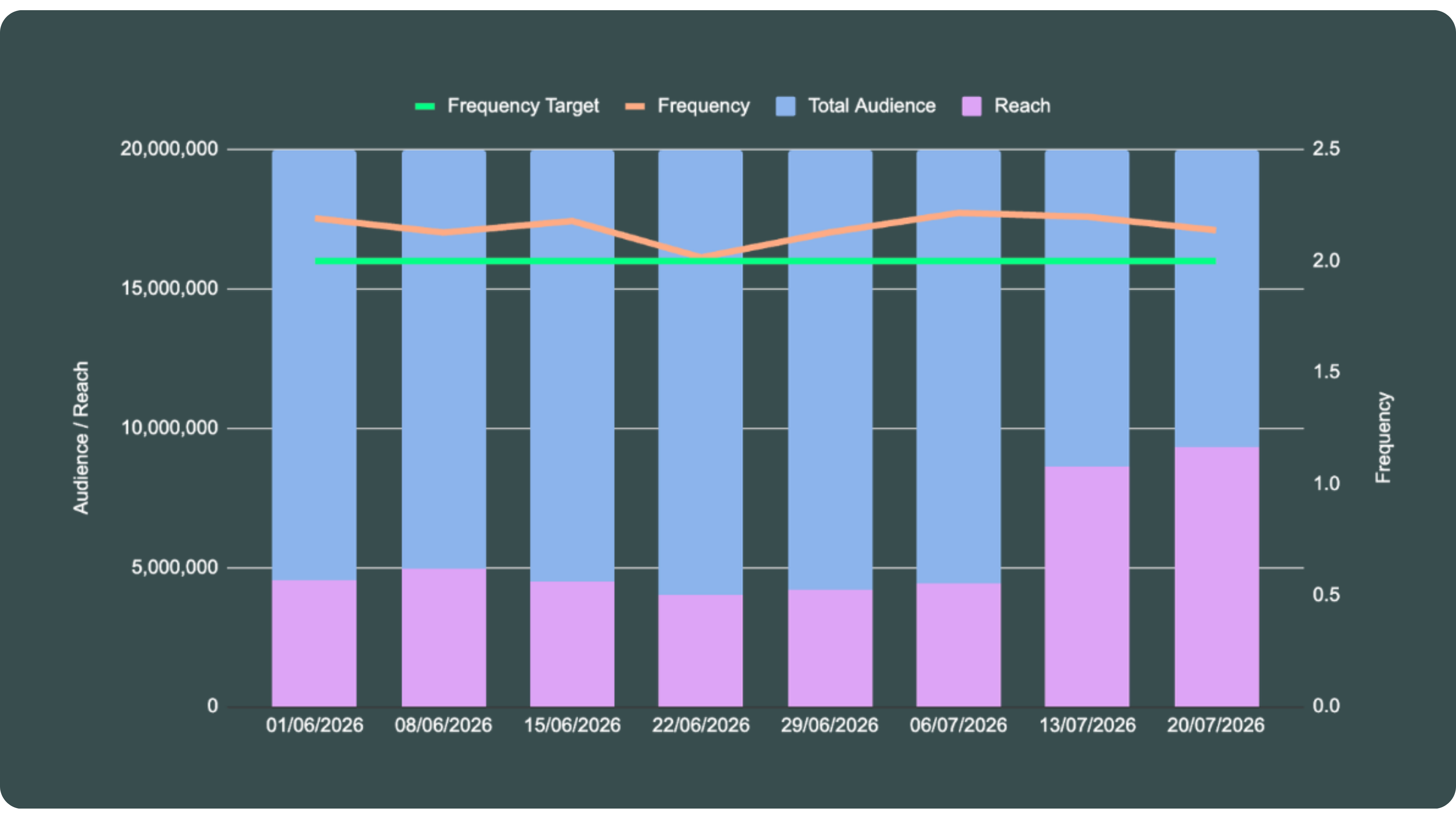
Although it wasn’t a KPI of the awareness campaign, CPA improved during the same period despite the increase in spend, which is not typical when scaling budgets. In this case, maintaining sufficient reach and frequency together allowed the platform to continue finding incremental demand while reinforcing previous exposure.
The relationship isn’t always linear, but it’s a useful reminder that media investment shouldn’t be judged purely on cost efficiency. Sometimes increasing investment improves campaign effectiveness because it allows the fundamentals of reach and frequency to work together.
The Takeaway
Reach and frequency cannot be planned in isolation from each other, or from the medium carrying the message. Both need to be considered together, with enough investment behind them to build memory and influence future buying decisions.
Meta’s research demonstrates how repeated exposure can strengthen mental availability across its platforms, but every medium builds memory differently. Understanding how attention varies by channel is what allows advertisers to determine the appropriate level of frequency, rather than applying the same target across every media plan.