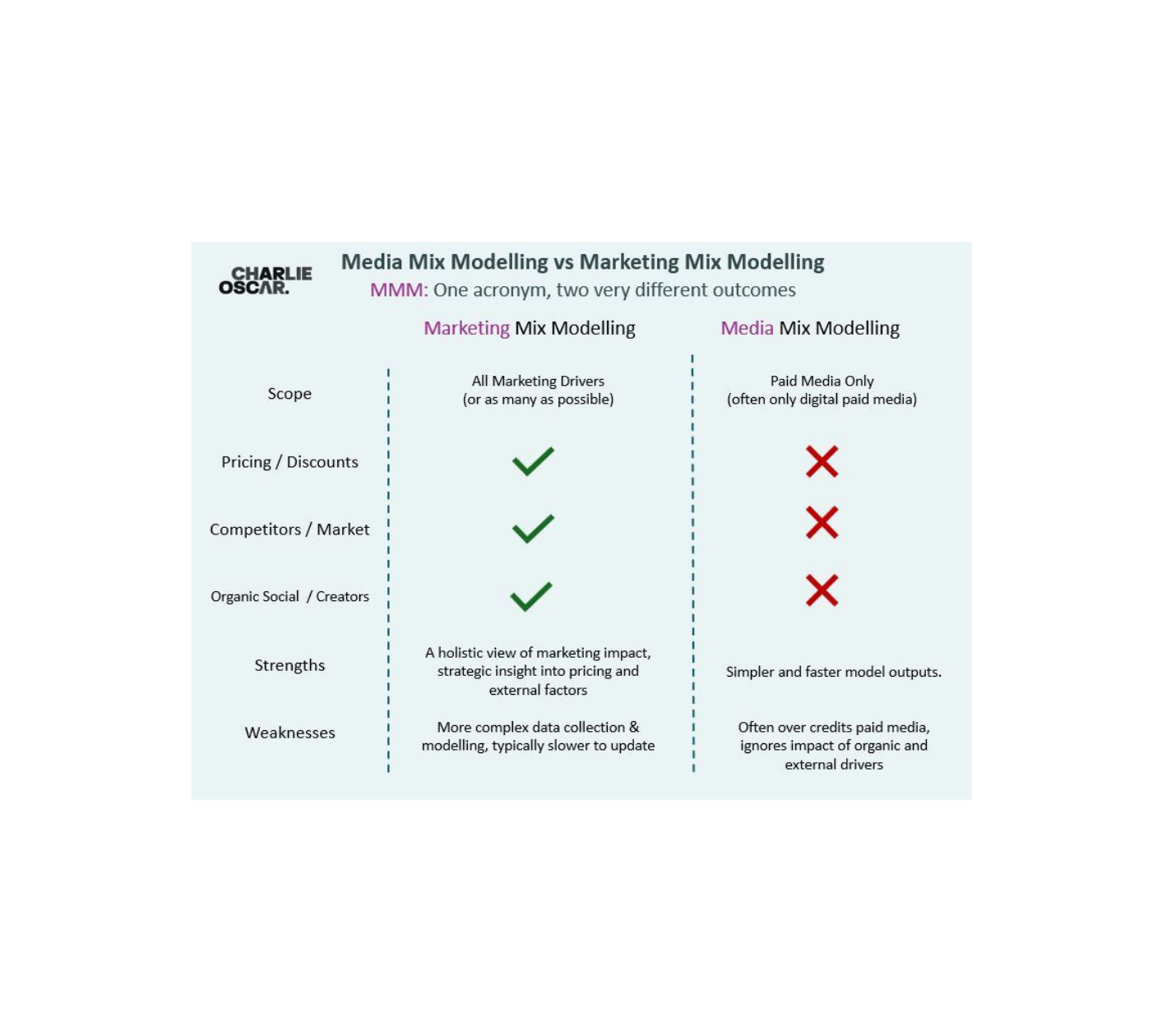
The acronym “MMM” is widely used in marketing measurement conversations. The problem is that it often refers to two different things.
Sometimes it means Marketing Mix Modelling.
Sometimes it means Media Mix Modelling.
They sound similar, but they answer different questions, use different data inputs, and operate at different levels of the business. In practice, the distinction matters because it changes what decisions the model can support.
What is Marketing Mix Modelling?
Marketing Mix Modelling (MMM) is designed to explain what drives incremental business outcomes across the full set of commercial and marketing drivers.
Paid media is only one part of that system.
A typical Marketing Mix Model includes variables such as:
- Paid media activity
- Pricing changes
- Promotions and discounting
- Distribution changes
- Seasonality
- Competitor activity
- Economic conditions
- External factors such as weather
The objective is not simply to understand marketing performance. It is to separate the impact of paid marketing from everything else that affects demand.
For example, if revenue increases by 20%, a Marketing Mix Model attempts to quantify how much of that change was driven by:
- Increased paid media investment
- A promotional period
- A broader rise in category demand
- Distribution expansion
- Seasonal effects
The model effectively answers a commercial question: what actually created incremental growth?
This broader view is why Marketing Mix Models are typically used to inform budget allocation, long-term planning, and investment trade-offs across marketing and commercial levers.
What is Media Mix Modelling?
Media Mix Modelling takes a narrower view. It focuses only on paid media channels.
Instead of modelling the entire commercial environment, Media Mix Models typically analyse:
- Spend by channel
- Impressions or reach
- Clicks or conversions
- Media performance over time
By limiting the scope to paid channels, Media Mix Models can often be built faster and updated more frequently. The data is usually easier to access and more consistent across markets.
This makes them useful for questions such as:
- How should I allocate the next £1 of media budget?
- Which paid channels show diminishing returns?
- Where are marginal returns strongest in the current environment?
The trade-off is that the model does not explicitly control for broader business drivers.
That limitation changes how the results should be interpreted.
Why does the difference matter?
If the objective is purely paid media optimisation, it can be tempting to assume the distinction is academic.
In practice, it affects how accurately the model attributes performance.
Without broader market and commercial inputs, Media Mix Models can struggle to separate media impact from underlying demand shifts.
Consider a simple scenario.
Paid search investment increases by 10% during a period where overall category demand increases by 15%.
A Media Mix Model may attribute most of the resulting revenue growth to paid search activity. But part of that growth may simply reflect stronger market demand.
This creates several common biases.
1. Channels that capture demand can appear overvalued
Channels that perform strongly during high-demand periods, such as:
- Paid Search
- Shopping
- Affiliates
Can appear more incremental than they actually are.
These channels often perform best when demand is already elevated (for example during discount periods or seasonal peaks). Without modelling demand drivers directly, the model may attribute that demand uplift to media
2. Channels that build demand can appear undervalued
Channels that invest ahead of demand spikes are harder to evaluate in a media-only framework.
Examples include activity that supports:
- Product launches
- Seasonal build-up periods
- Brand awareness or upper-funnel reach
If a channel contributes to demand that materialises later, a model focused only on immediate paid performance may underestimate its contribution.
3. External effects are harder to isolate
Markets are influenced by events outside the paid media system.
For example:
- High-reach press coverage
- Creator content that drives awareness
- Viral social activity
- Weather or macroeconomic shifts
Marketing Mix Models attempt to capture these influences through external variables. Media Mix Models generally do not.
As a result, sudden demand shifts caused by external exposure can be incorrectly attributed to paid channels.
When should you use Media Mix Modelling vs Marketing Mix Modelling?
Both approaches can be useful. The choice depends on the decision horizon and scope of the question.
Media Mix Modelling tends to work best when:
- The focus is short-term media allocation
- Paid channels represent the majority of controllable marketing activity
- Frequent updates are required to guide optimisation
- Data availability outside paid media is limited
In these situations, a faster model focused on media performance can provide useful directional guidance.
Marketing Mix Modelling tends to work best when:
- The objective is understanding incremental growth drivers
- Marketing investment must be evaluated relative to pricing, promotions, or distribution
- The business is making budget allocation decisions across multiple levers
- Long-term planning or scenario modelling is required
Because it accounts for a wider set of drivers, Marketing Mix Modelling is generally better suited to strategic investment decisions rather than tactical optimisation.
Do the models usually agree?
In many cases, the directional answer to “where should the next £1 go?” will be similar across both approaches.
But there are also situations where the results diverge.
This usually happens when demand is being influenced by factors that sit outside the paid media system, including promotions, macroeconomic changes, or external exposure.
Without controlling for those factors, media-only models can over or underestimate the contribution of specific channels.
The marketing industry has never been particularly disciplined with acronyms.
Using MMM to refer to both Marketing Mix Modelling and Media Mix Modelling has made the situation worse.
They are related approaches, but they answer different questions and operate at different levels of decision-making.
So the next time someone references “MMM”, it’s worth clarifying which version they mean.
Because the difference is not just semantic, it affects what the model can actually tell you.
Award Winning Thinking
Featured for big wins across Marketing Science, Influencer, Paid Media, Creative, and Consultancy.