In most creator campaigns we analyse, less than 30% of total commercial impact is captured through tracked links and discount codes.
Yet those metrics are often used as the primary performance signal.
If you’re judging creator investment on clicks and redemptions alone, you’re not measuring ROI. You’re measuring the most convenient fraction of it.
In our analysis across multiple sectors, for every £1 of directly attributed revenue from creators, we typically observe an additional £3-£5 in indirect impact through brand search, direct traffic, and improved paid media efficiency.
The issue isn’t the channel. It’s the measurement framework.
Why do clicks and codes systematically understate value?
Clicks and codes feel robust because they create a clean line between action and sale. They are easy to report and easy to compare.
But creator influence rarely operates in a single-session journey.
A typical path looks more like this:
- Someone sees content from a trusted creator.
- Brand familiarity and intent increase.
- Days later, they search for the brand or click a paid ad.
- The conversion is attributed to search or paid social.
The original creator touchpoint receives no credit.
This is not a tracking failure. It’s a structural limitation of last-click and session-based attribution.
Creators disproportionately drive:
- Brand search demand
- Direct traffic
- Higher click-through rates on branded search
- Improved conversion rates in retargeting
If you don’t measure those spillover effects, you are systematically undervaluing the channel.
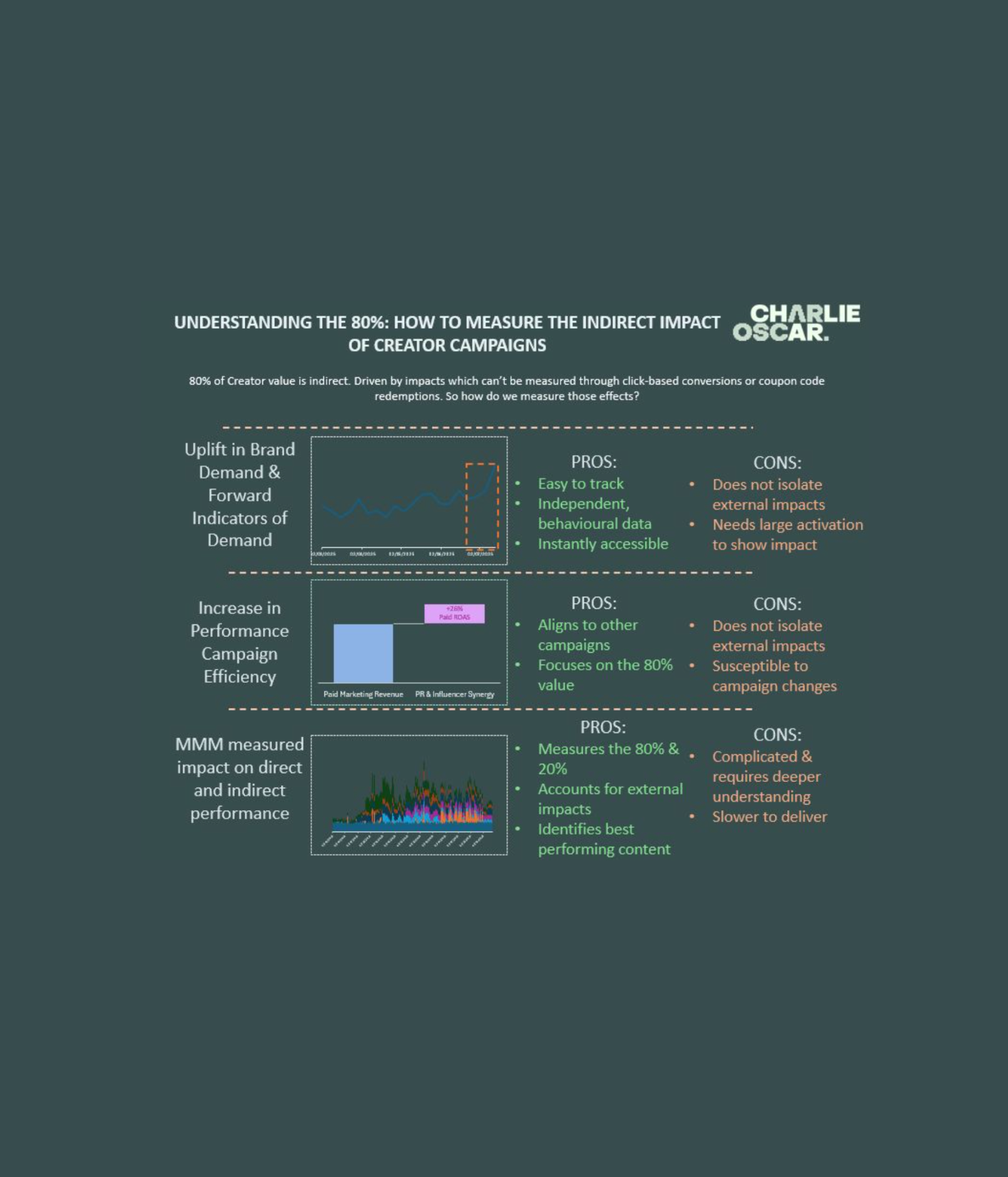
How can you measure the indirect impact more robustly?
There isn’t a single perfect method. But there are three approaches that, used together, give a far clearer picture.
1. Does brand search demand increase when creator investment increases?
Brand search is one of the clearest observable signals of increased intent.
When creator activity scales, we would expect to see:
- An uplift in branded search volume
- Growth relative to previous years (controlling for seasonality)
- Outperformance versus key competitors
Google Trends is often a useful directional tool here. It’s imperfect, but it gives a real-time view of demand shifts.
This approach won’t isolate causality. External factors can influence search demand. But if increased creator weight coincides with disproportionate brand search growth, that is a meaningful signal.
2. Do performance channels become more efficient?
If creators are driving incremental consideration, performance media should work harder.
What we typically examine:
- Branded search CTR before, during, and after creator bursts
- CPC trends on branded and competitor terms
- Conversion rate shifts in paid social and retargeting
A practical approach is to establish a four-week pre-campaign baseline, then compare in-flight and post-campaign performance.
Where we see sustained improvements in efficiency during creator-heavy periods — without major structural changes in bidding or creative — that suggests interaction effects between channels.
The limitation is obvious: correlation is not causation. Media optimisations can confound the signal. But repeated patterns across multiple cycles increase confidence.
3. Can Marketing Mix Modelling isolate incremental contribution?
If you want a more defensible estimate of total impact, econometric modelling is the most robust route.
A well-specified MMM can:
- Estimate incremental sales driven by creator investment
- Separate direct and indirect effects
- Account for competitor activity, seasonality, macro factors
- Quantify lag structures and carryover
Critically, it can answer more strategic questions:
- Which creator archetypes drive the highest marginal return?
- Which platforms create sustained demand versus short bursts?
- What is the diminishing return curve as spend scales?
MMM is not simple. Model error, data quality, and stakeholder trust all matter. But it moves the conversation from reporting outputs to informing allocation decisions.
What happens when you combine these methods?
No single metric should determine budget.
But when you observe:
- Brand search growth
- Improved paid media efficiency
- Positive incremental contribution in MMM
All moving in the same direction, the probability that creators are driving meaningful incremental value increases materially.
In practice, what we often see is this:
The content that drives tracked sales is not always the content that drives total value.
Hard “buy now” messaging may generate the measurable 20–30%.
Content that builds affinity and credibility tends to drive the remaining 70%+ through demand creation and channel interaction.
If you optimise only for tracked conversions, you risk systematically biasing investment toward short-term capture at the expense of long-term value creation.
So what needs to change?
Creator measurement should not sit inside affiliate reporting.
It should sit inside your broader decision-support framework, alongside search, paid social, TV, and other demand drivers.
The objective is not to prove creators “work.”
It is to understand:
- Their incremental contribution
- Their interaction effects
- Their marginal return at scale
- Their role in demand creation versus demand capture
When you measure creators in isolation, they look inconsistent.
When you measure them as part of the system, their contribution becomes clearer.
And in most cases, materially larger than the clicks suggest.
Award Winning Thinking
Featured for big wins across Marketing Science, Influencer, Paid Media, Creative, and Consultancy.