The Era of Creative Diversity & Activation Speed
For years, paid social performance was driven by targeting precision. Micro-segmentation allowed media buyers to extract incremental efficiency by narrowing audience definitions and layering exclusions.
As automation has expanded, the leverage has shifted away from manual targeting inputs and toward the signals the algorithm can extract from your ads.
The Algorithm Has Changed (And So Must You)
Platform algorithms increasingly learn from creative signals – who stops scrolling, who watches, who clicks, who converts – and then use those engagement patterns to expand delivery toward similar users.
Platform systems are now better at recognising similarity between assets. When ads share the same structure, pacing, message framing, or visual composition, they are interpreted as closely related inputs.
Incremental tweaks – swapping headlines, adjusting colours, editing the first three seconds – often fail to create meaningfully distinct learning signals. Audience overlap increases. Fatigue accelerates.
The Insight: The "Entity ID" Trap
Here is where most brands fail. They mistake volume for variation.
It is common to see accounts running 80, 100, even 150+ assets per campaign. On inspection, the majority share the same message architecture and visual structure. A different opening hook on the same video. A new font on a static image. To the human eye, these look like credible variants. To Meta’s algorithm, they are identical.
The introduction of an Entity ID makes this clear. This mechanism groups similar creatives under a shared identity. If you upload 100 subtle variants, the algorithm groups them, treats them as a single entity, and fatigue sets in rapidly. Conversely, 15-20 clearly differentiated creative themes and formats, distinct in visual style, with a clearly communicated benefit and targeted persona, will outperform the 100 subtle variants every time.
One hundred echoes deliver far less value than twenty distinct voices.
The Impact: Diversity + Volume
When asset volume is rebuilt around clearly differentiated themes, performance becomes more stable and more scalable.
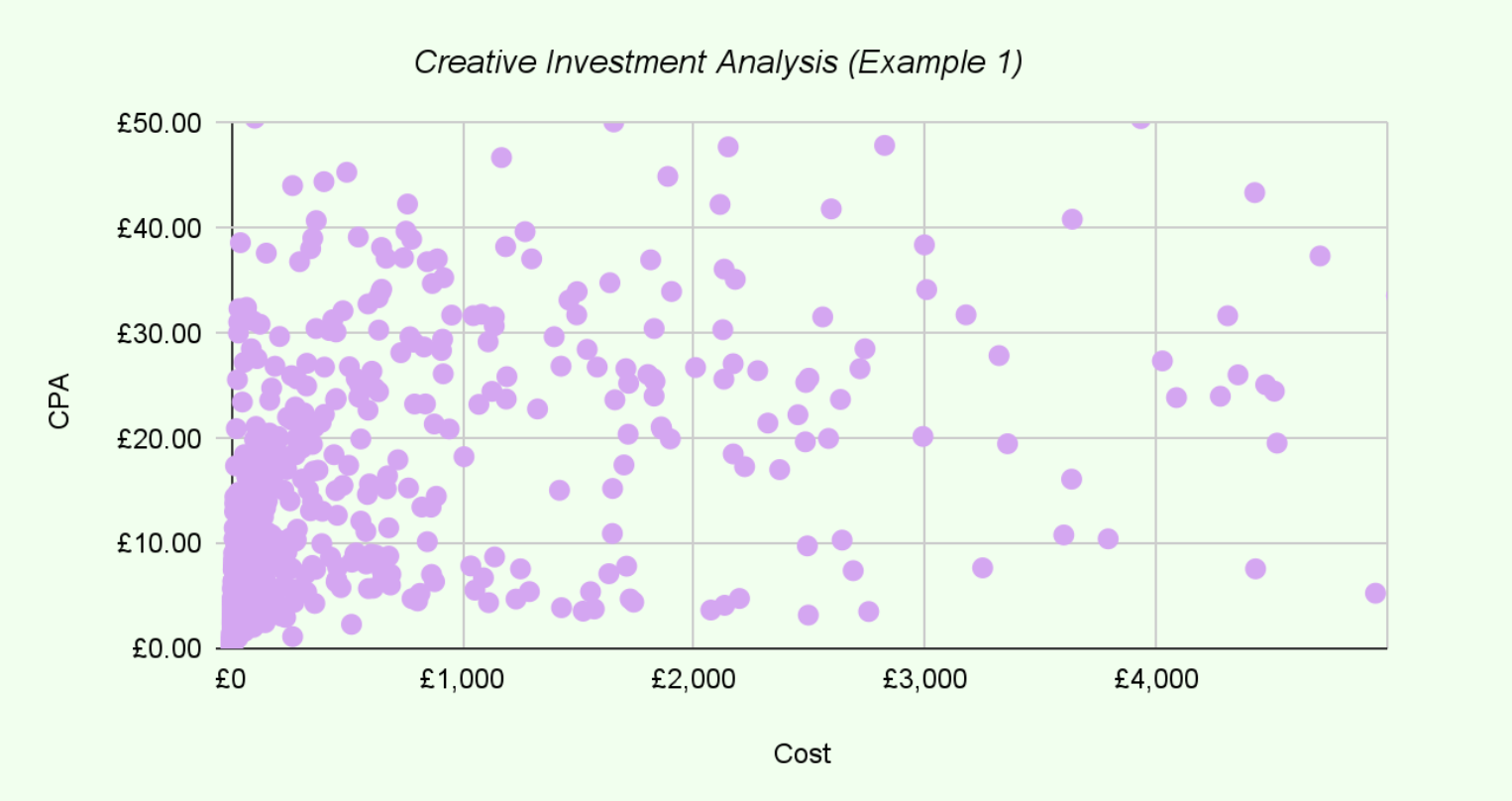
The two scatter plot visualisations below illustrate how an effective creative strategy directly influences scale and efficiency. Each data point represents an individual ad unit. The first chart shows a weak relationship between CPA and individual ad spend. Low CPA ads are not consistently receiving higher investment. This typically indicates structural similarity across assets – the system struggles to identify clear winners because signals overlap.
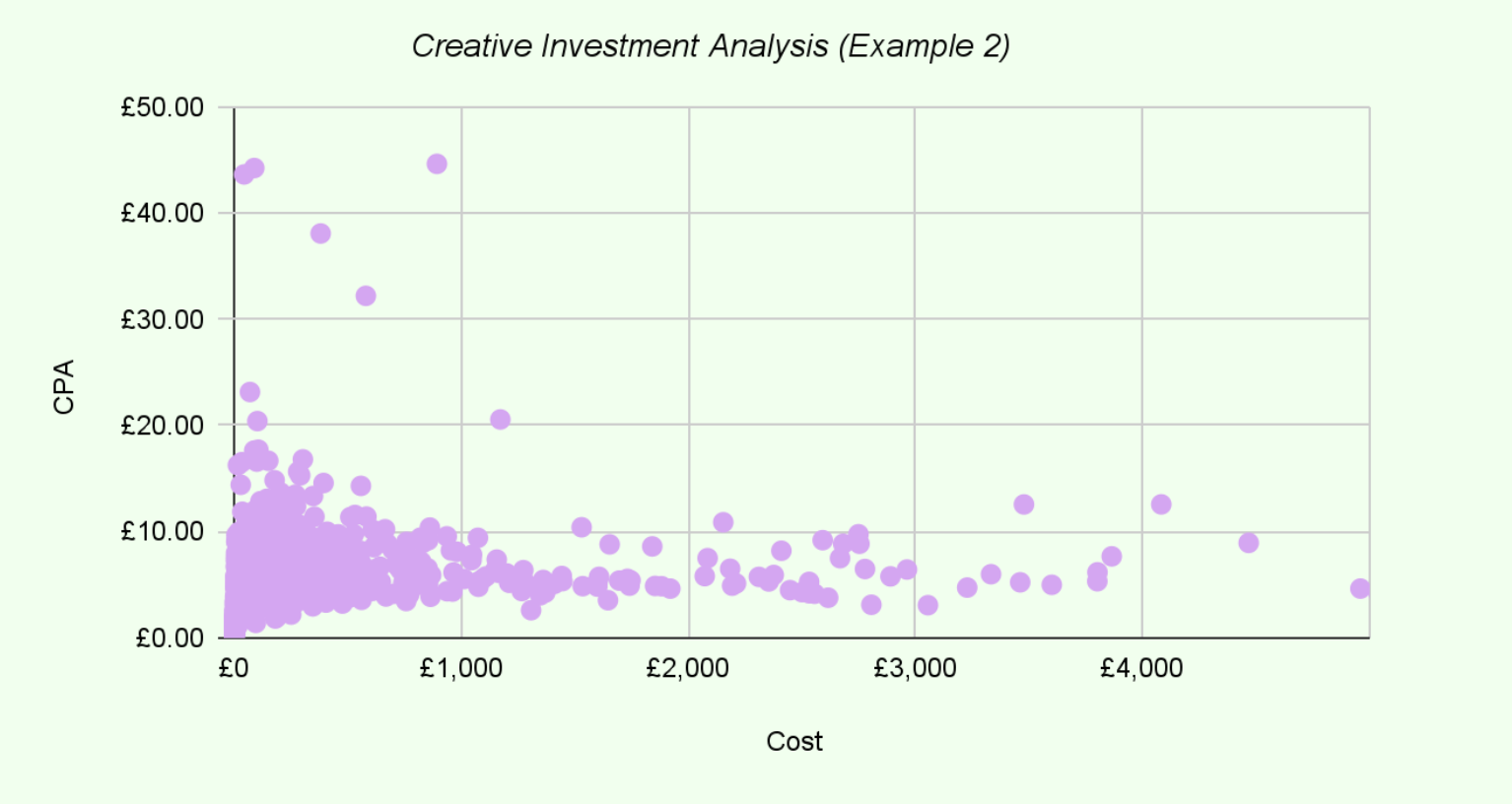
In contrast, the second chart shows a flatter, more linear relationship. Ads with lower CPA are able to absorb significantly higher levels of spend and results.
In both charts, a large cluster of ads sits close to the y-axis – low spend, limited scale. These are assets that never generated strong enough differentiation to drive volume. That cluster represents inefficiency.
Steps to Pioneer Creative Diversity
To conquer this new landscape, you must rethink your production pipeline. This places new demands on creative and media teams alike. Here is how to adapt.
1. Abandon “Iterative” Thinking for “Thematic” Thinking
Your creative strategy must be built on distinct pillars, not minor edits. For example:
- The Problem/Solution Angle: Direct, logical, benefit-led
- The Social Proof Angle: UGC-style, testimonial-heavy, raw
- The Lifestyle Angle: Aspirational, polished, brand-building
- The Founder Story Angle: Origin-led, belief-driven, narrative-based
Each of these is a different Entity ID. Each unlocks a different pocket of inventory and a different segment of users.
2. Break the Silo Between Media and Creative
Creative teams need clearer guidance on asset volume, formats, video lengths and variation. They cannot operate in a vacuum. Media teams need to obtain faster insights on what works so new creative angles can be developed.
If the media buyer sees that “Problem/Solution” assets are driving 3x ROI compared to “Lifestyle,” that insight must reach the creative team immediately. The feedback loop must be instant.
3. Measure Creative, Not Just Campaigns
Stop looking at campaign-level ROAS as the only measure of success. Drill down. Which creative themes are holding retention? Which formats drive the highest click-through rate? Use this data to inform the next sprint.
What’s Next?
The brands that will outperform in 2026 and beyond will not be those producing the highest number of assets.
They will be those operating structured creative systems – continuously introducing differentiated themes that allow the algorithm to explore new pockets of demand.
Audit your live ads. If most share the same template, performance risk is already building. Brand consistency cannot become creative sameness. Outperformance requires testing angles that stretch the brand – not repeating the safest version of it.
Redefine your social creative strategy. Build for diversity and watch the results follow.
Award Winning Thinking
Featured for big wins across Marketing Science, Influencer, Paid Media, Creative, and Consultancy.