Media Mix Modelling (MMM) provides brands with a strategic advantage to outperform their sector. Despite increasing conversation around uptake of MMM within businesses, there remains a disconnect between having the data and getting value from it.
Many teams invest in the analysis and sit through the presentations, yet fail to operationalise the findings. Old habits are hard to break, and without turning the data into action, decisions revert back to last click attribution.
Having MMM data is redundant unless it is used to challenge the status quo. The most effective brands don’t just sit on these insights; they use them to create tests, validate assumptions and gain a competitive advantage.
How Do You Turn MMM Insights into Real Business Decisions?
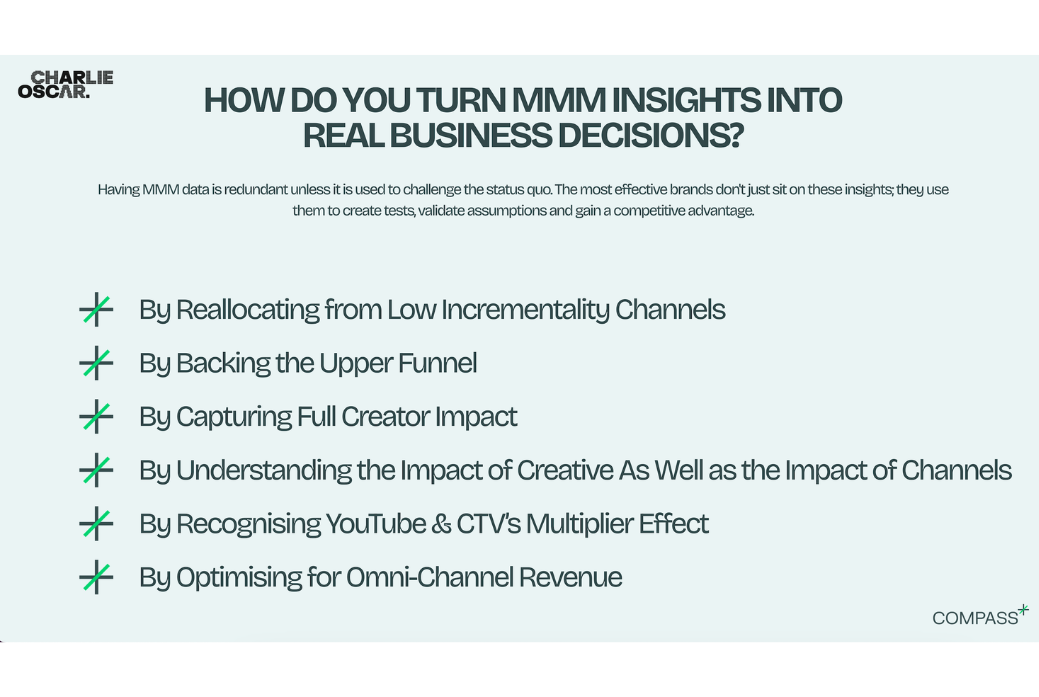
1. By Reallocating from Low Incrementality Channels
Leaders stop funnelling budget towards brand search and retargeting campaigns under the illusion of efficiency. MMM frequently reveals that Brand Search has low incrementality (often less than 10%). With this data, brands can confidently cut excess spend here and channel investment into engines of net new demand. Despite this consistently low incrementality, I continue to see brands spending 20-30% of search budget on brand campaigns. Frequently even higher, recently a well established brand spending 75% of budget on brand search.
2. By Backing the Upper Funnel
The “brand vs. performance” debate is becoming obsolete. Data consistently shows that 40-70% of all high-quality organic traffic initiates with upper-funnel activity; display, video, and influencer marketing, and build measurement frameworks which measure their impact on the future alongside their impact on the present.
3. By Capturing Full Creator Impact
Smart marketers don’t obsess over tracking direct redemptions or links alone. They measure the ripple effect: increased awareness and surges in branded search. We often see that 80% of influencer ROI lives in these indirect metrics, and only strategic brands know how to measure (and mobilise) it.
4. By Understanding the Impact of Creative As Well as the Impact of Channels
Smart MMM deployment allows leaders to identify the creative and messages which are driving strongest uplifts, allowing us to optimise what we say as well as where we say it. Separating the synergy effects generated from different content strategies, and isolating 30% stronger incrementality from Creator Ads compared to BAU Ads.
Leaders embed this learning into creative strategy alongside spend optimisation.
5. By Recognising YouTube & CTV’s Multiplier Effect
YouTube is more than a brand play; it is an accelerator for lower-funnel activity. MMM shows that its true influence on search lift is often twelve times what last-touch metrics report. If your media plan treats YouTube as expendable, you are likely starving your pipeline.
6. By Optimising for Omni-Channel Revenue
Industry frontrunners don’t just optimise for Direct-to-Consumer (DTC). They follow the trail across Amazon, retail, and every touchpoint Meta or TikTok sends downstream. Customers are often as loyal (or even more loyal) to their buying platforms than the brands they are buying. Your customers move between buying channels, so your MMM needs to understand these effects. Leaders don’t let their DTC, Retail and Amazon channels fight against each other for the same customer demand, but instead focus on the incremental demand which lifts all ships.
How Do You Make MMM Your North Star?
Real change begins by shifting the culture, not just the data on the dashboard.
1. By Mapping New Insights to Familiar Metrics
Translate sophisticated outputs into language your team understands. Anchor new value measures side-by-side with last-click data. This ensures the reality of incrementality hits home, not hypothetically, but tangibly.
2. By Integrating MMM into Routines
Forget annual or quarterly cycles. Integrate MMM figures into weekly and monthly routines to ensure key growth factors remain top of mind.
3. By Validating with Testing
When discrepancies arise, do not hesitate to double down on testing (geo splits, holdouts, rapid iteration). The objective is certainty you can act on.
TrustedHousesitters: A Case Study in Incrementality

We applied this exact philosophy with TrustedHousesitters, moving them from 84% bottom-of-funnel activity to just 54% by trusting the data over the dogma. By divesting from low-incrementality brand search and prioritising high-impact drivers like Meta and YouTube, we achieved a 17% drop in CPA and a 288% YoY increase in Meta spend, all while hitting CAC targets.
The result? A community that has grown to 270,000 members and record-high SEO acquisitions. This proves that when you stop letting last-click attribution dictate strategy and start using MMM to back the upper funnel, you don’t just stabilise growth; you accelerate it.
The brands that are growing are those that are recalibrating, measuring, and moving faster.
Step past the comfort of the status quo and make your MMM outputs the metric that matters.
Award Winning Thinking
Featured for big wins across Marketing Science, Influencer, Paid Media, Creative, and Consultancy.